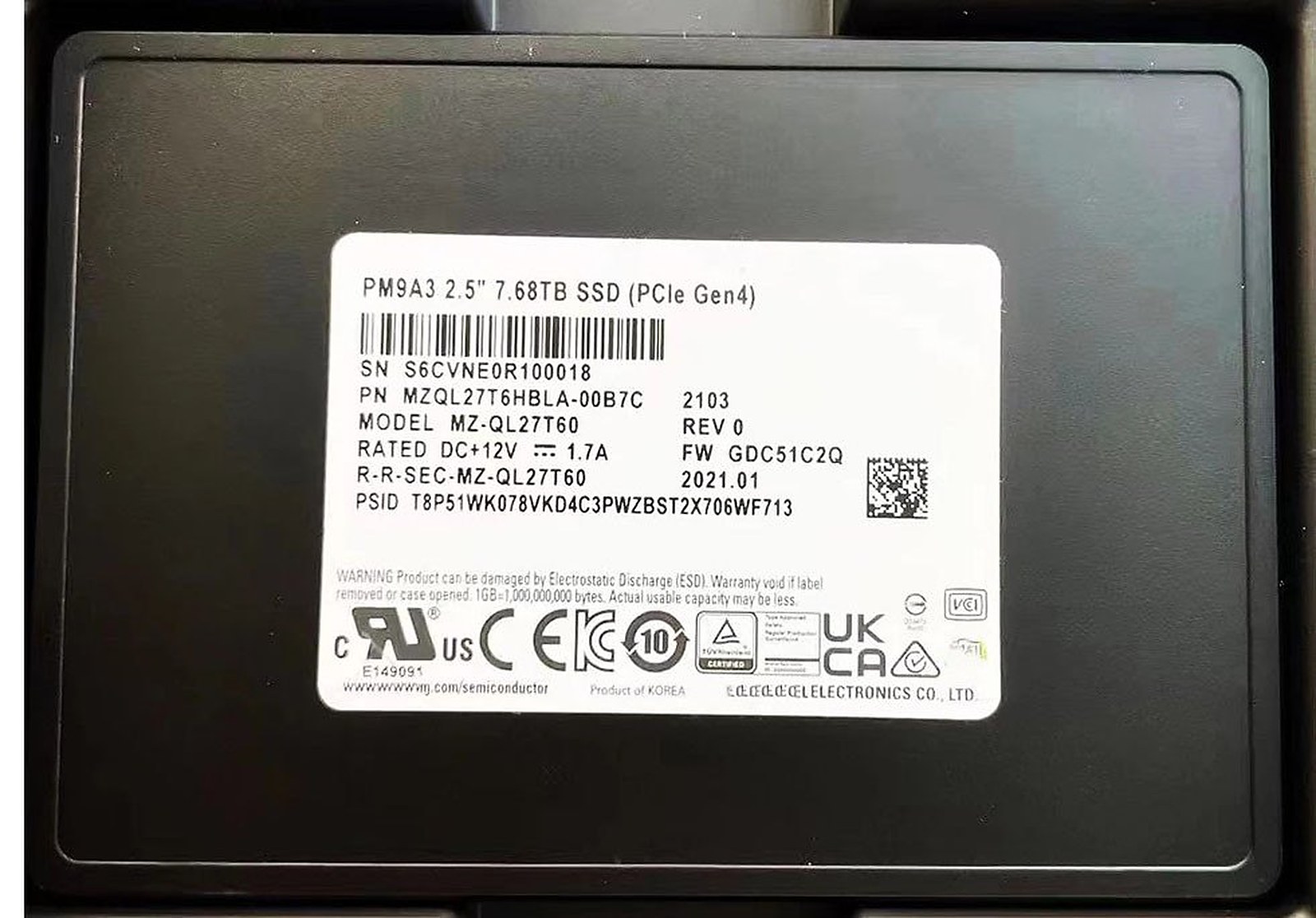
Samsung PM9A3 U.2 NVMe Buying Guide 2026: 960GB vs 1.92TB vs 3.84TB vs 7.68TB
The Samsung PM9A3 has quietly become the default read-intensive NVMe drive for data center builds in 2026. It is not the fastest Gen4 SSD on the market, and it is not trying to be. What it offers is a rare combination: enterprise-grade features — power-loss protection, AES 256-bit encryption, TCG Opal, 1 DWPD endurance — at a price per terabyte that undercuts most retail NVMe lines, in a standard 2.5-inch U.2 form factor that drops into almost any server built in the last six years.
The question most buyers ask us is not whether to buy the PM9A3, but which capacity. The family ships in four U.2 sizes — 960GB, 1.92TB, 3.84TB and 7.68TB — and in 2026 the four sizes behave like four different products: different performance ceilings, different channel availability, and price spreads that would have been unthinkable two years ago. This guide walks through each capacity with real tracked market pricing, a spec comparison, and a workload-first selection framework.
Why the PM9A3 Is the Default Enterprise NVMe Buy in 2026
Three things make the PM9A3 the line we recommend most often this year.
First, the platform is mature and predictable. Every capacity runs the same Samsung 128-layer V-NAND TLC behind the same Elpis controller, on PCIe Gen4 x4 with NVMe 1.4. There are no firmware surprises between sizes, and the drive negotiates down cleanly to Gen3 for older backplanes, so mixed fleets are not a problem.
Second, the endurance class matches how most enterprise storage is actually used. The PM9A3 is a 1 DWPD read-intensive drive across the whole family. For CDN origin storage, virtualization datastores, database read replicas, VOD libraries and backup targets, 1 DWPD is the right class — you are not paying mixed-use prices for write endurance you will never touch.
Third, the used and recertified channel is deep. Hyperscalers deployed PM9A3 at enormous scale from 2022 onward, and those drives are now rotating out of first-line service. That creates a graded secondary market that did not exist for earlier generations, and it changes the economics of every capacity tier — more on that below.
If you are still weighing NVMe against SATA for a given tier, read our NVMe vs SATA enterprise storage guide first — the interface decision comes before the capacity decision.
The Four Capacities at a Glance
Here is the spec sheet that matters for procurement. Note that performance is not flat across the family: larger capacities wire more NAND dies in parallel, so sequential writes and random IOPS climb as capacity doubles.
| Capacity | Part Number | Seq. Read / Write | Random Read (4KB) | Endurance |
|---|---|---|---|---|
| 960GB | MZQL2960HCJR | 6,500 / 1,500 MB/s | 580K IOPS | 1 DWPD (≈1,752 TBW) |
| 1.92TB | MZQL21T9HCJR | 6,800 / 2,700 MB/s | 850K IOPS | 1 DWPD (≈3,504 TBW) |
| 3.84TB | MZQL23T8HCLS | 6,800 / 3,700 MB/s | 1,000K IOPS | 1 DWPD (≈7,008 TBW) |
| 7.68TB | MZQL27T6HBLA | 6,800 / 4,100 MB/s | 1,100K IOPS | 1 DWPD (≈14,016 TBW) |
Two practical takeaways. First, sequential reads are nearly saturated from 1.92TB up — a Gen4 x4 link tops out around 7GB/s, so all four capacities read at close to wire speed. Second, write performance is where capacity pays: the 3.84TB writes 2.5 times faster than the 960GB, and the 7.68TB nearly three times faster. If your workload has any meaningful write component, the smallest drive is the wrong economy.
2026 Price Snapshot by Capacity
This is where 2026 gets interesting. The NAND market is in an upcycle, and the four capacities are priced by four different logics. The table below summarizes asking prices we tracked in August and early September 2026 across public channel listings — these are asking prices, not transaction prices, and volume orders typically close below asking.
| Capacity | Channel & Condition | Tracked Asking Range | Sample |
|---|---|---|---|
| 960GB | eBay / reseller, new | $291–$450 | n=7 |
| 960GB | US/EU retail, new | $576–$925 | n=7 |
| 1.92TB | EU retail, new | $1,283–$1,776 | n=7 |
| 1.92TB | US / Middle East retail, new | $1,750–$1,978 | n=7 |
| 3.84TB | US retail, new | $1,990–$2,195 (median ≈$2,088) | n=5 |
| 7.68TB | Recertified (1-yr warranty) | $988–$1,188 | n=6 |
| 7.68TB | US/EU retail, new | $3,040–$4,600 | n=6 |
A few things stand out. The PM9A3 960GB shows the widest channel spread of the family — the same new drive lists anywhere from $291 on eBay reseller channels to $925 at traditional US distributors. In a tight NAND market, small-capacity drives are where gray-channel pricing shows up first, so source verification matters more at 960GB than anywhere else in the line.
The PM9A3 1.92TB carries a genuinely strange signal: we tracked a used pull on eBay at $1,998, above the EU new retail band of $1,283–$1,776. When used drives trade above new retail, the market is telling you supply is constrained and regional channels are mispriced. Buyers sourcing from EU distributors this quarter are getting a better deal than buyers chasing US spot stock.
The PM9A3 3.84TB is the calmest market in the family: five US retail asking prices between $1,990 and $2,195, a cross-channel spread within ±5%, and a median around $2,088. That tightness makes it the easiest capacity to budget against and the one we can quote most predictably.
The PM9A3 7.68TB is a two-tier market with a three-times price gap: recertified drives with a one-year warranty trade at $988–$1,188, while new Western retail runs $3,040–$4,600. For density builds, the recertified tier is the best value in the entire product family right now — provided the drives come with documented health data.
Sources for the snapshot include Aaawave, Newegg, Best Buy, eBay US/UK sellers, Senetic UK/IL, Multitronic, comel-it, Balta.pl, ServerSupply, Newtown Spares and Avanti Global Resources, collected August 7 through September 1, 2026. The full per-listing dataset, with methodology and original URLs, is in our Used Server Price Index 2026.
How to Choose: Matching Capacity to Workload
Specs and prices in hand, here is the framework we walk buyers through.
960GB: boot, cache and edge
The 960GB is the right drive when the job is small and the slot count is high: boot and OS volumes, logging tiers, caching layers in front of slower storage, and edge nodes where capacity matters less than consistency. At $291–$450 in reseller channels it is also the cheapest entry into Gen4 NVMe with power-loss protection. Just do not buy it for write-heavy primary storage — 1,500 MB/s sequential writes and 70K random write IOPS will be the bottleneck long before capacity is.
1.92TB: the general-purpose datastore drive
For virtualization datastores, general-purpose database volumes and mid-size file services, 1.92TB is the workhorse. It doubles the 960GB's capacity while lifting random reads to 850K IOPS and writes to 2,700 MB/s. The current EU pricing anomaly ($1,283–$1,776 new, below US retail and below some used listings) makes this the capacity where supplier geography most changes your landed cost.
3.84TB: the all-flash array sweet spot
If you are populating an all-flash array or a dense virtualization cluster, the 3.84TB is usually the right answer. It has the best price per terabyte at new retail in the family — two 1.92TB drives cost roughly the same as one 3.84TB but consume twice the bays and deliver lower per-drive write performance. At 3,700 MB/s writes and 1,000K random read IOPS it is also the first capacity where the drive, not the PCIe link, is no longer the limiting factor on reads.
7.68TB: density plays and the recertified opportunity
The 7.68TB exists for one reason: capacity per slot. Twenty-four of them in a 2U box is 184TB raw. New retail pricing of $3,040–$4,600 is hard to justify against the 3.84TB unless slots are genuinely scarce — but the recertified market changes the math completely. At $988–$1,188 with a one-year warranty, recertified 7.68TB drives cost less per terabyte than any other PM9A3 in any condition. For read-intensive archives, media libraries and backup targets, this is the standout buy of 2026, as long as health data comes with the drive.
New vs Recertified vs Used Pulls
Three condition grades circulate in the PM9A3 market, and they are not interchangeable.
New-sealed drives carry full warranty and zero hours, and in 2026 they carry a supply premium — hence the wide retail spreads in the table above. Recertified drives (manufacturer or large-channel recertification, typically with a fresh one-year warranty) are the middle path and currently the best value at 7.68TB. Used server pulls are the cheapest route but vary enormously: two pulls of the same model can differ by years of power-on time and 90 percentage points of remaining life.
Our rule is simple: never buy a pull without its SMART data. Percentage life remaining, power-on hours, reallocated sectors and media errors tell you what the drive actually is. Every used PM9A3 we ship goes out with that readout attached, plus a full-surface write/read pass and NIST 800-88 sanitization on request. If a seller cannot or will not provide SMART data, the discount is not worth the risk.
Frequently Asked Questions
Which PM9A3 capacity is best for an all-flash virtualization array: 1.92TB, 3.84TB or 7.68TB?
For most arrays, the 3.84TB. Compared with the 1.92TB it doubles capacity and lifts sequential writes from 2,700 to 3,700 MB/s and random reads from 850K to 1,000K IOPS, at roughly the same cost per terabyte at retail — while halving the bay count. The 7.68TB wins only when slots are the hard constraint; if they are, the recertified tier ($988–$1,188) is far more economical than new retail. The 960GB is not an array drive — it is for boot, cache and logging roles.
Is the PM9A3 fast enough compared with newer Gen5 drives?
For read-intensive enterprise workloads, yes. All PM9A3 capacities read at 6,500–6,800 MB/s, close to the practical ceiling of a Gen4 x4 link, and random read latency is what actually dominates datastore and CDN performance. Gen5 drives raise peak bandwidth, but at several times the price per terabyte — and most Gen3/Gen4-era server backplanes cannot run them at full speed anyway.
Are recertified PM9A3 drives reliable enough for production?
Yes, when they come with documentation. Manufacturer-recertified PM9A3 drives carry a fresh warranty (typically one year) and have passed a factory test pass. The 7.68TB recertified channel we track ($988–$1,188, one-year warranty) is legitimate volume from hyperscale rotation. What you should avoid is undocumented bulk stock with no warranty and no health data — that is a different product at a similar price.
Why is there such a big price spread between channels in 2026?
The 2026 NAND upcycle is squeezing supply unevenly. Traditional Western distributors carry higher overhead and later restock cycles, so their prices sit well above eBay and gray-channel listings — for the 960GB, the gap is $291–$450 versus $576–$925 for the same new drive. The spread is real, but it also means channel verification (part number, firmware, packaging) is part of the purchase decision this year.
Can you ship PM9A3 drives internationally, and in what condition?
Yes. We stock and source all four PM9A3 capacities in new-sealed, recertified and graded used conditions from our Hong Kong warehouse, with full export documentation and express freight to most markets in 3–7 days. Every used drive ships with its SMART readout; volume orders can mix capacities and conditions to hit a budget target.
Our Verdict for 2026
Buy the capacity that matches the workload, not the one with the lowest sticker price. Boot and cache roles: 960GB. General datastores: 1.92TB — and check EU sourcing this quarter. All-flash arrays: 3.84TB, the family's value anchor. Dense read-intensive capacity: recertified 7.68TB, the single best dollar-per-terabyte deal in enterprise NVMe right now.
Whatever capacity you land on, treat 2026 as a verification year: wide channel spreads mean the same part number is effectively a different product depending on where it comes from. Buy from sources that show their data.
Talk to Us About Your PM9A3 Order
HKCHL stocks and sources the full Samsung PM9A3 U.2 family — 960GB, 1.92TB, 3.84TB and 7.68TB — in new, recertified and SMART-verified used condition, shipped worldwide from our Hong Kong warehouse. Send us your target capacity, quantity and condition preference, and we will come back with a quote against live channel stock, usually within 12 hours.
Need current pricing on a specific PM9A3 capacity or a mixed-capacity build? We source and fully test enterprise NVMe, DDR4/DDR5 ECC memory and Dell PowerEdge, HPE ProLiant and Lenovo ThinkSystem servers from our Hong Kong warehouse. Contact us with your requirements — we answer within 12 hours.