When AMD launched the EPYC 9004 "Genoa" family in late 2022, it set new ceilings for x86 server performance: up to 96 Zen 4 cores, 12-channel DDR5, and PCIe Gen5. For enterprise buyers, Genoa was the future. In 2026, it has become something more interesting — it is entering the used market, and that changes the sourcing calculus for every data center refresh on a budget.
Cloud providers retire servers on three-to-five-year cycles, and the first large Genoa fleets deployed in 2023 are now being decommissioned. Based on our market observation through the first half of 2026, used Genoa supply is rising steadily while prices remain well below the launch-era street price of new units. For buyers who have waited for a DDR5 generation to become affordable, this window is opening now.
Why Used EPYC Genoa Is Entering the Market Now
The decommissioning wave follows a predictable curve. Genoa launched as a premium part for hyperscalers and large enterprises in 2023, reached mainstream adoption through 2024, and is now approaching the end of its first lease and cloud-retirement cycle. Large ODM and cloud fleets refresh on schedule, not on desire — and each refresh releases racks of fully functional, lightly-used 9004 parts into secondary channels.
Several forces are accelerating the flow in 2026:
- PCIe Gen5 and DDR5 density upgrades. Early Genoa adopters are moving to higher-core SKUs or to the newer EPYC 9005 (Turin) generation for core-count and AI workloads, cascading their Genoa hardware downstream.
- Intel competitive pressure. 4th and 5th Gen Xeon refreshes have pushed AMD roadmaps and budget cycles forward, widening the pool of traded-in SP5 platforms.
- Huaqiangbei and global channel liquidity. The Hong Kong and Shenzhen secondary market already carries consistent Genoa inventory, a leading indicator for the rest of the world.
The result: used EPYC Genoa is transitioning from a niche curiosity to a mainstream refurbished-server option — exactly the phase where early buyers capture the best price-to-performance.
The Genoa Lineup at a Glance
The 9004 family spans a wide performance ladder, and not all SKUs depreciate the same way. The models we see most in the used channel are the high-core flagships that anchor AI and virtualization fleets:
- EPYC 9654 — 96 cores / 192 threads, 2.40GHz base, 360W. The volume leader of the used Genoa wave.
- EPYC 9554 — 64 cores / 128 threads, 3.10GHz base, 360W. The density sweet spot for dual-socket builds.
- EPYC 9474F — 48 cores at very high clocks, for frequency-sensitive database workloads.
- EPYC 9354 — 32 cores, 3.25GHz base, a strong single-socket value part.
Used EPYC Genoa Pricing in 2026: What the Market Is Asking
We track asking prices for used EPYC Genoa parts through the same channel methodology as our Used Server Price Index. The snapshot below was collected on August 17, 2026 from public seller listings — asking prices, not transaction prices, and volume deals typically close below asking.
- EPYC 9654 (96 cores) — retail used parts are asking $1,790–$2,899, with a median around $2,400 across six live listings. Some unlocked retail units are listed at $2,150–$2,899; 44 sold on one active listing, so real volume is moving.
- QS (Qualification Sample) parts — engineering samples from Chinese-channel sellers ask $1,236–$1,749. These are dramatically cheaper but are not formal retail units; treat them as a higher-risk tier and verify provenance before buying.
- New-box reference — retail-new 9654 listings start above $2,299, so the used tier is roughly 20–30% below new for the same silicon.
- Adjacent Milan parts — for context, a used EPYC 7543 (32-core Milan) asks $695–$890, showing how Genoa pricing sits above the SP3 generation while the platform premium narrows.
The practical takeaway: the 96-core flagship has crossed the "two-thirds of new" threshold, and high-volume buyers quoting against live inventory can typically secure better than listing prices. That is the pattern we see before every used-server generation matures.
SP5 Platform Checklist for Genoa Builds
Genoa runs on the SP5 socket (LGA 6096), which is not interchangeable with the SP3 platform of Rome and Milan. Before you commit to used Genoa CPUs, verify the platform layer:
- Board support. Confirm the server or motherboard explicitly supports EPYC 9004 with the right BIOS/AGESA revision — R7615/R7625, DL385 Gen10 Plus/Gen11, SR635/SR645/SR665 class platforms, and comparable boards.
- DDR5 RDIMMs. Genoa requires 12-channel DDR5 (up to 4800 MT/s officially). Used Genoa CPU deals frequently appear without memory — budget for RDIMM kits separately.
- PCIe Gen5 risers and cabling. The platform's PCIe Gen5 lanes are only useful with Gen5-capable risers, backplanes, and NICs; legacy Gen4 accessories will still work at Gen4 speeds.
- Power envelope. Flagship 96-core parts run up to 360W. Verify PSU headroom and cooling for the CPU class you select.
Genoa vs Milan vs Turin: Which Used Generation Fits?
The used-market choice in 2026 is a three-way decision:
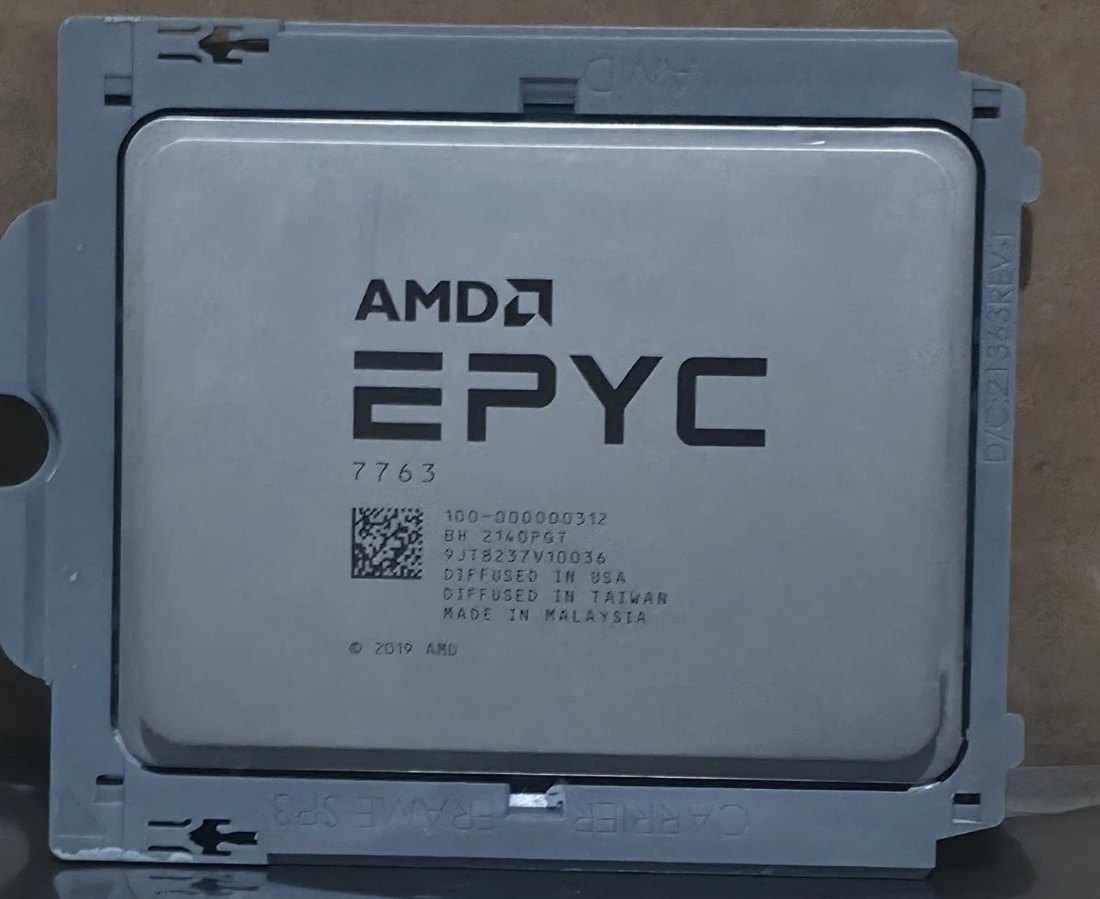
- Milan (EPYC 7003, SP3) — the mature, lowest-cost option. A used EPYC 7763 (64 cores) or 7543 delivers strong value on cheap DDR4 platforms. Best when budget dominates and the workload is bandwidth-insensitive.
- Genoa (EPYC 9004, SP5) — the sweet spot for DDR5 and PCIe Gen5 requirements. Higher per-socket density than Milan at a fraction of new-Genoa cost. The choice for virtualization, database consolidation, and mixed AI-inference fleets.
- Turin (EPYC 9005, SP5) — up to 192 cores and newer microarchitecture, but used supply is only beginning to appear. We run a Turin waitlist for buyers planning 2027 refreshes.
For most organizations refreshing in 2026, used EPYC Genoa is the pragmatic middle path: DDR5 and Gen5 capability today, at a price the CFO will accept.
Sourcing and Testing Advice for Used Genoa CPUs
Buying decommissioned CPUs is a quality game. We apply the same discipline to Genoa as to every part we ship:
- Verify OPN and variant. Confirm the full OPN against AMD's official SKU list and check for QS versus formal retail markings before purchase.
- Match steppings for 2P builds. Mixed steppings cause subtle NUMA instability; matched pairs should come from the same batch.
- Full-core stress test. Every unit should pass a complete POST and all-core stress run on a reference SP5 board, with memory channels exercised.
- Thermal and power logging. Under-load temperature and power draw flag degraded heat-spreaders and out-of-spec silicon.
If you are evaluating used Genoa CPUs for a fleet refresh, HKCHL sources tested 9004 parts against live refurbisher inventory and confirms platform compatibility before shipping. Our AMD EPYC stock page covers the full SP3 and SP5 range.
Planning the Migration: Common Genoa Pitfalls
The most expensive mistake in the used Genoa market is not buying the wrong CPU — it is buying the right CPU for the wrong platform assumptions. Based on our observation of buyer requirements, five errors recur:
- SP5 CPU without an SP5 board. Genoa and Turin share the SP5 socket, but they do not fit SP3 platforms at all. Verify your server model supports EPYC 9004 before committing.
- Treating QS parts as retail. Qualification Samples are legitimate silicon but carry no formal retail warranty path, and stepping behavior can differ from production parts. The price gap is real; so is the risk. Only choose them with clear eyes and a verified test pass.
- Under-budgeting memory. Genoa's 12-channel DDR5 controller only delivers its advantage with enough RDIMMs. A used CPU deal without memory can become a surprise line item when you fill twelve channels.
- Oversizing for the workload. A 96-core 9654 is compelling on paper, but a 32-core 9354 or 48-core 9474F often matches latency requirements at half the TDP and cost. Match cores to the concurrency your workload actually exhibits.
- Ignoring cooling and power headroom. Flagship Genoa parts at 360W need serious chassis cooling and PSU margin — a workstation-style chassis may simply throttle them.
None of these are deal-breakers. They are all resolved by a proper requirements pass and a supplier who tests on reference hardware before shipping — which is why we publish our per-unit testing process and confirm platform compatibility before any 9004 order leaves Hong Kong.
Finally, keep the refresh calendar in mind. Genoa decommissioning will continue through 2027 as Turin adoption grows, which means prices are likely to soften gradually rather than collapse. Buying now captures availability and matched-pair quality while supply is clean; waiting may save a little money but trades away the best-tested inventory. For fleets on a fixed refresh window, the decision is timing — and 2026 is the year Genoa enters the value zone.
Conclusion
The used EPYC Genoa market has reached the phase where volume, price, and platform maturity align. DDR5 servers no longer require a new-server budget; PCIe Gen5 is within reach of refurbished deployments; and the 96-core density that was premium two years ago is now a cost-effective baseline. Based on our market observation, the strongest buying window for used EPYC Genoa is the next two to three quarters, before demand catches up with decommissioning supply.
HKCHL helps enterprise buyers navigate this window — from SKU selection and platform compatibility checks to matched-pair sourcing and global logistics from Hong Kong. If you are planning a Genoa-based refresh, our team is happy to discuss requirements and provide a quotation. Contact us to start the conversation.