NVIDIA L4 vs A100 vs H100 in 2026: Inference GPU Buying Guide
The GPU conversation in most enterprise procurement meetings has shifted. Two years ago the question was which accelerator to buy for training. In 2026 the volume question is which accelerator to buy for inference — and the answer is frequently not the newest or the largest card.
That shift has real budget consequences. A single H100 80GB PCIe card lists between $25,000 and $32,200 in current channels. An L4 24GB lists between $2,492 and $4,040. They are separated by roughly an order of magnitude in price, and for a meaningful share of production inference workloads, the cheaper card delivers the service level you actually need.
This guide compares the three NVIDIA accelerators most enterprise buyers are specifying in 2026 — L4, A100 40GB and H100 80GB — using tracked channel pricing, and sets out which workloads justify which tier.
The Three Tiers, and What Separates Them
The three cards below are also stocked as standalone parts — NVIDIA L4 24GB, A100 40GB and H100 80GB — and buyers weighing CPU-side selection for the same hosts should read our CPU for AI inference guide.
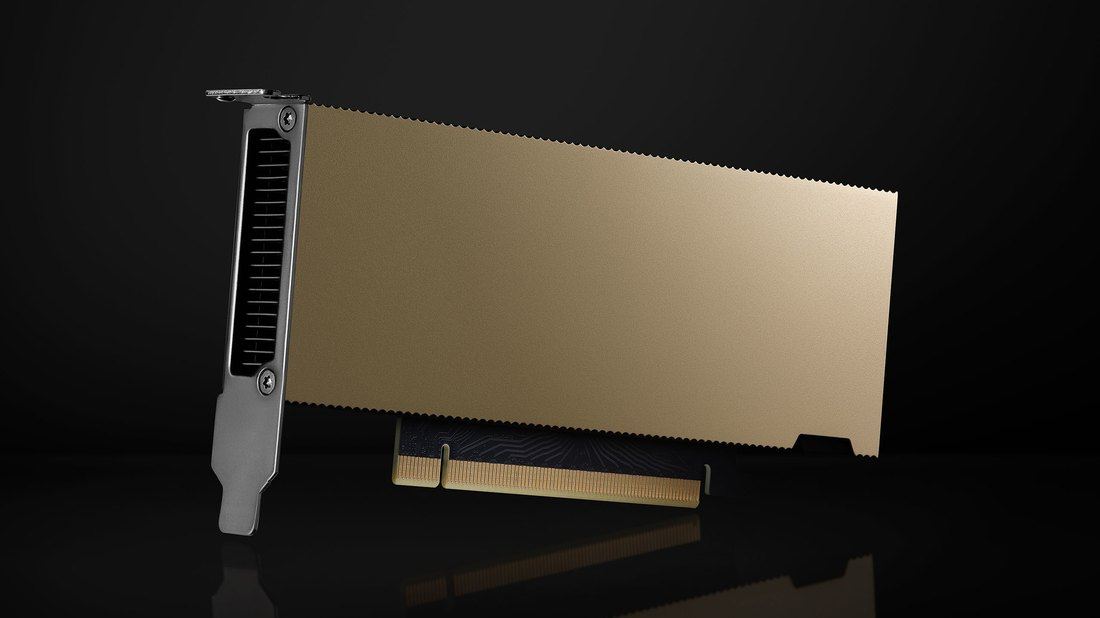
NVIDIA L4 24GB is a 72W PCIe card built for efficiency rather than peak throughput. It fits in a standard server slot without auxiliary power, which means it can be added to existing 2U servers without re-engineering power or cooling. For video transcoding, smaller language models, recommendation serving and edge inference, it is the capacity-per-watt leader in this comparison by a wide margin.
NVIDIA A100 40GB is the previous-generation data center workhorse. Production ended in 2024, so what circulates today is existing stock and secondary-market supply. That makes A100 40GB a discontinued but still well-supported part — with the pricing behavior of an end-of-life product rather than a current one.
NVIDIA H100 80GB is the current high end: the largest memory pool, the highest bandwidth and the strongest throughput of the three. It is also the only one of the three where availability, not price, is frequently the deciding constraint.
What the 2026 Price Data Shows
Based on asking prices tracked across US, EU and APAC channels in September 2026:
| GPU | Memory | Channel pricing (new) | Secondary market |
|---|---|---|---|
| NVIDIA L4 | 24GB | $2,492–$4,040 (median ≈ $2,950) | — |
| NVIDIA A100 40GB | 40GB | — | $3,150–$5,870 (tracked range $5,500–$7,900) |
| NVIDIA H100 80GB PCIe | 80GB | $25,000–$32,200 | ≈ $28,000 |
Two observations matter for budget planning.
The L4 and A100 40GB have converged in price. A new L4 and a used A100 40GB now sit in overlapping ranges. That is unusual — normally the newer architecture carries a premium — and it reflects the fact that A100 supply is finite and being priced as legacy inventory while L4 remains in active production.
H100 pricing is a different order of magnitude and is sample-thin. Our tracked range for H100 PCIe is based on a small number of listings and should be treated as indicative rather than as a settled market clearing price. SXM5 variants sit higher still. Buyers should expect H100 quotes to move with allocation rather than with list pricing.
Matching the Card to the Workload
The most expensive mistake in inference GPU procurement is buying by benchmark ranking instead of by workload. The three cards map onto genuinely different jobs.
Where the L4 is the right answer
The L4 is the correct choice when the workload is many concurrent, modest-sized inferences rather than a few large ones. Video transcoding and analytics pipelines, embedding and retrieval serving, recommendation models, small and mid-size language models, and inference at edge or branch locations all fit here. The 72W envelope is the decisive advantage: it means density — several cards per server, in servers you already own.
If your model fits comfortably in 24GB and you are serving many requests rather than pushing the frontier of model size, paying H100 prices is buying throughput you cannot use.
Where the A100 40GB still earns its place
The A100 40GB remains a sound buy for organizations that need more memory and bandwidth than an L4 provides but cannot justify current H100 pricing. Larger language models, mixed training and fine-tuning alongside inference, and HPC workloads that benefit from the A100's bandwidth profile all qualify.
The caveat is lifecycle. A100 40GB is out of production; support horizon and resale value both decline from here. If you are buying A100 today, buy it for a workload you can migrate, and confirm the card's provenance and health — secondary-market GPUs need verification just as much as secondary-market drives do.
Where the H100 is unavoidable
The H100 80GB is the answer when the 80GB memory pool is a requirement rather than a preference: large models that will not fit in 40GB, high-throughput serving where latency targets cannot be met by smaller cards, and any environment where the workload is expected to grow into the card over its service life.
If you are specifying H100, treat lead time and allocation as the primary planning risk. Budget for the card and the schedule independently.
The Server Platform Question
GPUs are rarely bought in isolation, and the platform decision often constrains the GPU decision more than the reverse.
The L4's 72W envelope means it can go into a standard 2U server with no auxiliary power — including many current-generation and previous-generation platforms that are already in service. This is the lowest-friction path to adding inference capacity to an existing fleet.
The A100 and H100 both require substantially more power and cooling headroom, and typically a platform designed for them: appropriate PCIe or SXM topology, adequate airflow, and in the H100's case power provisioning that may require a facility conversation rather than just a server choice. When buyers ask us to compare GPU prices, the honest answer frequently involves comparing complete server configurations instead.
Frequently Asked Questions
Is an L4 enough for production LLM inference, or do I need an A100 or H100?
For small and mid-size models that fit within 24GB and for high-concurrency serving of modest requests, an L4 is often sufficient and dramatically cheaper to buy and run. The A100 or H100 becomes necessary when the model itself exceeds 24GB, when you need to fine-tune as well as serve, or when latency targets at high throughput cannot be met by the smaller card. Measure your actual model footprint and concurrency before defaulting to the largest option.
Why is a used A100 40GB priced close to a new L4?
Because the A100 40GB is out of production and its remaining supply is finite, while the L4 remains in active production with ongoing channel flow. The convergence is a supply artifact rather than a sign the two cards are equivalent — they serve different workload profiles, and the newer L4 carries a longer support horizon.
Which GPU should I choose if I also want to fine-tune models?
The A100 40GB or H100 80GB. The L4 is oriented toward inference and lighter workloads; fine-tuning larger models is where the wider memory buses and larger memory pools of the A100 and H100 matter. If you need both in one environment, the H100's 80GB pool gives the most headroom, at a corresponding cost.
Should I buy refurbished or used GPUs?
It can make sense for secondary workloads, provided provenance and health are verifiable and the reseller provides a warranty. Data center GPUs are generally more durable than their consumer counterparts, but the secondary market includes cards with unknown histories. Ask for the same evidence you would for storage: the card's origin, its operating history where available, and written warranty terms.
Can you supply GPUs as part of a complete server configuration?
Yes. We source NVIDIA L4, A100 40GB and H100 80GB alongside Dell PowerEdge, HPE ProLiant and Lenovo ThinkSystem server platforms from our Hong Kong warehouse, so buyers can specify a complete validated configuration rather than sourcing cards and chassis separately. Send us your workload requirement and we will propose the configuration and pricing.
Our Verdict for 2026
Do not default to the largest card. For high-concurrency, modest-model inference and video workloads, the L4 is the right purchase in 2026 and the 72W envelope makes it the only one of the three you can add to an existing server without a platform decision. The A100 40GB remains valid for larger models and mixed training-inference work, with the caveat that it is end-of-life and should be bought for a workload you can migrate. The H100 80GB is justified when the 80GB pool is a hard requirement — and when it is, plan around allocation and lead time, not around list price.
Talk to Us About Your GPU Requirement
HKCHL stocks and sources NVIDIA L4, A100 and H100 accelerators, alone or as part of complete validated server configurations, from our Hong Kong warehouse, shipped worldwide. Send us your model footprint, concurrency target and platform constraints and we will come back with a configuration and quote, usually within 12 hours.
Need current pricing on an inference GPU or a complete GPU server build? We source and fully test enterprise servers, GPUs, storage and DDR4/DDR5 ECC memory from our Hong Kong warehouse. Contact us with your requirements — we answer within 12 hours.