18TB vs 20TB Enterprise HDD in 2026: Capacity Buying Guide
Nearline hard drives have become the least predictable line item in enterprise storage budgets this year. Two forces are pulling in opposite directions: capacity demand from AI and analytics buildouts keeps rising, while the supply of high-capacity nearline drives has tightened enough that lead times on new orders now stretch to weeks or months depending on the part.
For buyers specifying 18TB and 20TB SATA drives, that combination means the old rules — buy the biggest drive you can afford, refresh on a three-year cycle — no longer produce the lowest cost per terabyte. This guide compares the four nearline models most enterprise buyers are evaluating in 2026 using tracked channel pricing, and sets out where each one actually earns its place.
Why 18TB and 20TB Are the Current Sweet Spot
The nearline market splits into three practical tiers. Drives below 16TB are being displaced by SSDs in performance roles and by denser HDDs in capacity roles, so their per-terabyte economics have stopped improving. Drives above 24TB carry a density premium that only pays off when bay count is the binding constraint. The 18TB and 20TB tier sits in between: mature enough that refurbished and recertified supply exists, dense enough that a 24-bay 2U chassis still delivers 432TB–480TB raw.
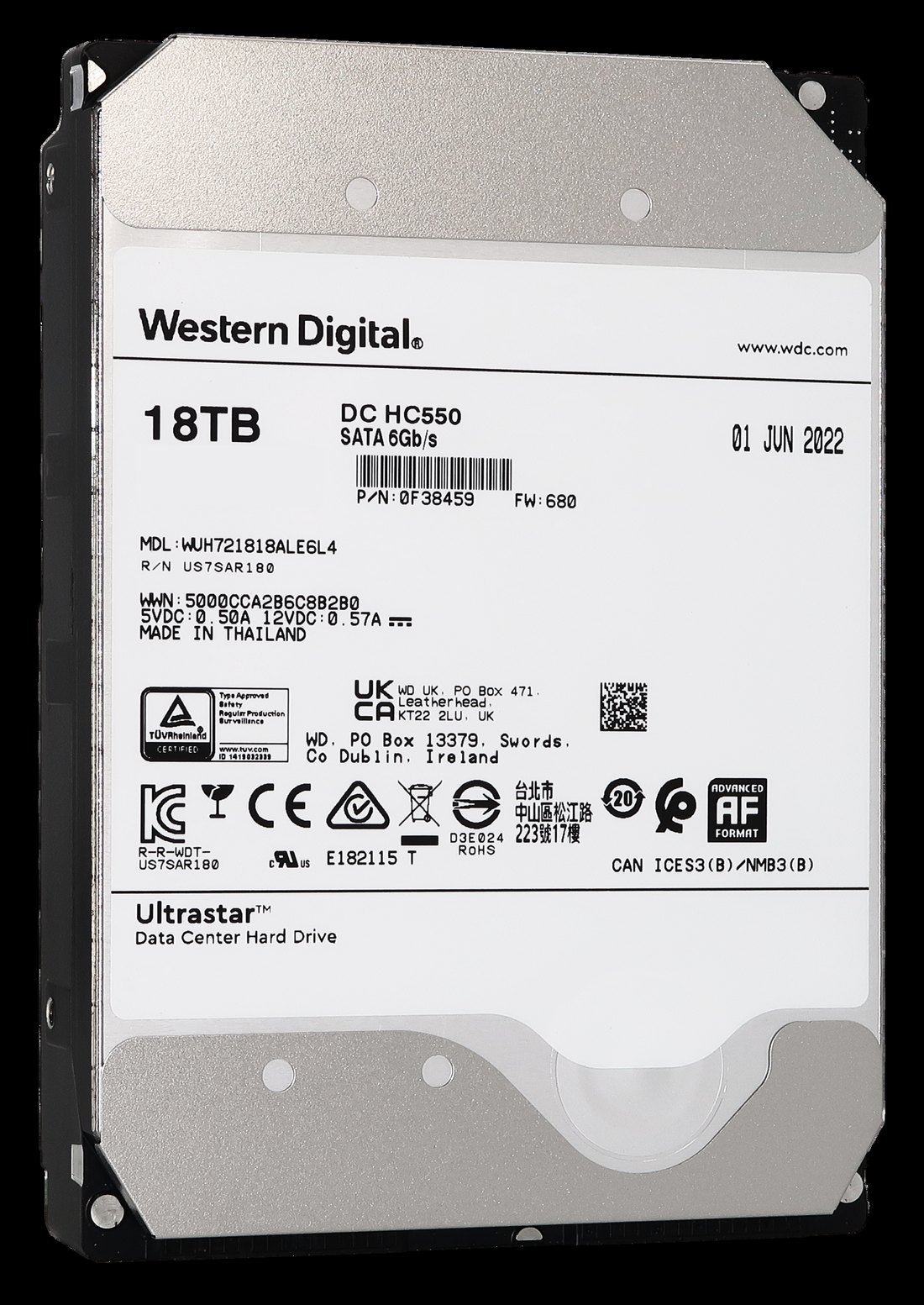
That is why the same four models keep appearing in enterprise RFQs. Seagate's Exos X18 16TB (ST16000NM002H class) and Exos X20 20TB (ST20000NM002H) dominate the SATA nearline channel. Western Digital's Ultrastar DC HC550 18TB (WUH721818ALE6L4) and HC560 20TB (WUH722020ALE6L4) cover the equivalent 18TB and 20TB positions on the WD side, and the HC550 in particular has become the reference part for used-market pricing.
For teams comparing solid-state alternatives in the same capacity band, our enterprise NVMe vs SATA SSD guide sets out where flash displaces nearline HDD and where it does not.
What the 2026 Price Data Actually Shows
Based on asking prices we tracked across US, EU and Hong Kong channels in September 2026, the spread between drives is driven less by specification than by condition and region.
| Model | Capacity | Used / refurbished | New (US/EU channel) | New (HK channel) |
|---|---|---|---|---|
| WD Ultrastar HC550 | 18TB | $380–$540 | $491–$834 | ≈ $692 |
| WD Ultrastar HC560 | 20TB | — | $479–$862 | — |
| Seagate Exos X20 | 20TB | $421–$600 | $581–$674 | $628–$897 |
| Seagate Exos X18 | 16TB | — | $600–$760 | ≈ $513 |
Three things stand out.
First, the used market is where the value is — if you can verify it. HC550 18TB drives trade between $380 and $540 in refurbished condition, against $491–$834 new. That is a 30–45% discount for a drive that, in a nearline array, will usually be deployed in a redundant configuration anyway.
Second, Hong Kong and APAC channels are genuinely cheaper on some parts. New Exos X18 16TB lists around $513 from a Hong Kong retailer versus $600–$760 in US retail channels. We have observed this gap persistently across the storage categories we track — it reflects landed cost and regional inventory, not product differences.
Third, the tiers overlap. A new 16TB and a used 18TB can land within a few dollars of each other per drive. Capacity per dollar, not capacity per drive, is what separates them.
Reading the Per-Terabyte Numbers
Sticker price comparisons mislead on HDDs because the cost driver is $/TB, and it moves non-linearly when condition is in play.
At the tracked midpoints, a used HC550 18TB at roughly $450 works out to about $25 per terabyte. A new HC560 20TB at roughly $670 is about $33.5 per TB. A new Exos X20 20TB at roughly $630 is approximately $31.5 per TB. The used 18TB is therefore around 25% cheaper per terabyte than the new 20TB — but it comes with a different warranty position and a finite remaining service life.
The calculation changes if you weight by density instead. Twenty-four 20TB drives give 480TB raw in 2U; twenty-four 18TB drives give 432TB in the same chassis. If your rack space or power budget is the constraint, the 11% capacity difference per bay can outweigh a 25% per-terabyte advantage, because it means one fewer enclosure, one fewer switch port and one fewer power drop.
The hybrid approach we recommend
Most enterprise buyers we work with do not choose one tier. The pattern that consistently produces the lowest blended cost is: new 20TB drives for the primary tier where warranty coverage matters, SMART-verified refurbished 18TB drives for secondary, backup and archive tiers where redundancy absorbs individual failures. This is the same logic that applies to memory and SSD procurement — match the condition grade to the criticality of the data, not to the whole array.
What to Verify Before You Buy Nearline HDDs
Hard drive condition grading is less standardized than SSD grading, and the used nearline market has real variance. Four checks separate a sound purchase from an expensive lesson.
SMART data, every time. Power-on hours, reallocated sector count, spin retry count and media errors are the minimum. A drive with 40,000 power-on hours and rising reallocated sectors is not equivalent to one with 12,000 hours and a clean table, even at the same price and same model number.
Part number and variant confirmation. The HC560 exists in SATA (ALE6L4) and SAS (BLE604) variants, and we have seen buyers receive the wrong one. The Exos X18 position is further complicated because ST16000NM002H appears in some channels labeled as Exos X24 16TB — a later SKU on the same platform — while the classic X18 part number is ST16000NM000J. If your array firmware or HBA compatibility list references a specific part number, confirm it in writing before shipment.
Format and sector configuration. 512e versus 4Kn matters for some HBAs and older arrays. Confirm what you are receiving, not what the listing implies.
Warranty terms in writing. Refurbished nearline drives typically carry a one-year warranty through the reseller. That matters more on HDDs than on SSDs, because mechanical failure modes are progressive and a drive that passes testing today can develop issues at month eight.
Frequently Asked Questions
Is 18TB or 20TB better value for a nearline backup array?
For backup and archive tiers, refurbished 18TB is usually the better value at roughly $25 per terabyte against roughly $31–$34 for new 20TB. The exception is when chassis or power density is the constraint — then 20TB wins because the capacity difference per bay reduces total enclosure count. Many buyers split the difference: 20TB new for the primary tier, 18TB refurbished behind it.
Should I buy Seagate Exos or WD Ultrastar for 18–20TB?
Both are tier-one nearline platforms with comparable reliability, and in practice the decision is driven by price and availability on the specific capacity you need rather than by brand. The WD Ultrastar HC550 18TB has the deepest refurbished supply and therefore the most competitive pricing; Seagate Exos X20 20TB has broader new-channel availability. We source both.
Are refurbished nearline hard drives safe for production storage?
In redundant configurations, yes — provided SMART data accompanies the drive and the reseller stands behind it with a warranty. A RAID or erasure-coded array tolerates individual drive failure by design, so deploying verified refurbished drives in secondary tiers is standard enterprise practice. We do not recommend undocumented used drives for a primary tier without redundancy.
Why have HDD prices stopped falling in 2026?
Capacity demand from AI and data center buildouts has absorbed the nearline supply that historically pushed prices down each cycle, and manufacturers have prioritized high-capacity production. The result is that the previous assumption — that waiting six months always means cheaper storage — no longer holds reliably for nearline HDDs. Buyers who have been deferring capacity purchases on that assumption are now finding that timing has worked against them.
Can you supply mixed 18TB and 20TB lots with SMART reports?
Yes. We stock and source Exos X18, Exos X20, Ultrastar HC550 and HC560 from our Hong Kong warehouse in new, refurbished and SMART-verified used condition, and we can build mixed-capacity lots to a target capacity and budget. Every used drive ships with its SMART readout, and volume orders can include full-surface testing and sanitization.
Our Verdict for 2026
For most enterprise buyers, the right answer this year is not a single drive. Specify new 20TB drives where warranty coverage and density justify the premium, and SMART-verified refurbished 18TB drives for secondary and archive tiers, where the roughly 25% per-terabyte saving compounds across a large deployment. Treat part-number confirmation and SMART data as non-negotiable on both paths — the nearline market in 2026 rewards buyers who verify and penalizes those who assume.
Talk to Us About Your Storage Requirement
HKCHL stocks and sources Seagate Exos and WD Ultrastar nearline drives in 16TB, 18TB and 20TB capacities from our Hong Kong warehouse, in new, refurbished and SMART-verified used condition, shipped worldwide. Send us your target capacity, quantity and condition preference and we will come back with a quote against live channel stock, usually within 12 hours.
Need current pricing on nearline HDDs or a mixed-capacity build? We source and fully test enterprise storage, DDR4/DDR5 ECC memory and Dell PowerEdge, HPE ProLiant and Lenovo ThinkSystem servers from our Hong Kong warehouse. Contact us with your requirements — we answer within 12 hours.