EPYC 9J14 vs Xeon 6760P
The EPYC 9J14 and the Xeon 6760P are both server processors we supply tested from Hong Kong, and the figures below are the same ones published on each product page. They share the same supply and warranty terms and separate on cores / threads, tdp, cache, so the decision is less about "which is better" and more about which of those differences your platform or workload can actually use.
Nothing on this page is a price: component pricing moved too fast in 2026 for a printed figure to stay honest, so both are quoted on request against confirmed stock with the date the quote holds until. If you are replacing a part, send the platform and we will confirm the population before you commit.
Side by side
EPYC 9J14 vs Xeon 6760P specifications
| Specification | EPYC 9J14 | Xeon 6760P |
|---|---|---|
| Cores / Threads | 96 cores / 192 threads per CPU | 64 cores / 128 threads |
| Socket | SP5 (LGA 6096) | not stated |
| TDP | 360W in OEM/secondary-market listings for this OPN; not confirmed by an AMD-published document | 330 W / Intel 3 |
| Cache | 384MB in OEM/secondary-market listings for this OPN; not confirmed by an AMD-published document | 320 MB |
| Memory | DDR5 platform (SP5). Channel count for this specific SKU is not published by AMD - confirmed against your platform's supported-CPU list at order time. | DDR5 (6400 MT/s) - 8 channels, no MRDIMM support |
| PCIe | PCIe Gen5 platform (SP5). Lane count for this specific SKU is not published by AMD - confirmed against your platform's supported-CPU list at order time. | PCIe 5.0, 88 lanes / 4 UPI links |
| Processor | AMD EPYC 9J14 (OEM / cloud-custom SKU) | not stated |
| Microarchitecture | Listed as Zen 4 by secondary-market sources; AMD publishes no specification page for this SKU | not stated |
| Orderable part number | 100-000000933 (100-000000933WOF also seen) | not stated |
| Part class | Server tray / OEM part - no boxed retail SKU | not stated |
| Launch | Q3 2023 (PassMark CPU Benchmark 'first seen on chart') | not stated |
| Clock | Not agreed between public sources: 2.40GHz in OEM/secondary-market listings for OPN 100-000000933, 2.6GHz in the PassMark CPU Benchmark record. We publish both rather than choosing. base / Up to 3.7GHz (PassMark CPU Benchmark record) max | 2.2 GHz base / 3.8 GHz max turbo |
| Platform | not stated | Intel Xeon 6 processors (Products formerly Granite Rapids) |
| Socket / Launch Date | not stated | FCLGA4710 / Q1'25 |
Rows that differ are highlighted. Figures are the same ones published on each product page; where a figure is community-sourced rather than vendor-published it is stated on that page. Confirm every part against your build sheet when ordering.
Where they differ
- ·EPYC 9J14 has the higher core count (96 vs 64); Xeon 6760P trades that for something else.
- ·Xeon 6760P is the better figure for power draw (360W in OEM/secondary-market listings for this OPN; not confirmed by an AMD-published document vs 330 W / Intel 3).
- ·EPYC 9J14 has the higher cache (384 vs 320); Xeon 6760P trades that for something else.
- ·Memory — EPYC 9J14: DDR5 platform (SP5). Channel count for this specific SKU is not published by AMD - confirmed against your platform's supported-CPU list at order time.; Xeon 6760P: DDR5 (6400 MT/s) - 8 channels, no MRDIMM support.
- ·PCIe — EPYC 9J14: PCIe Gen5 platform (SP5). Lane count for this specific SKU is not published by AMD - confirmed against your platform's supported-CPU list at order time.; Xeon 6760P: PCIe 5.0, 88 lanes / 4 UPI links.
- ·EPYC 9J14 lists the higher base clock (Not agreed between public sources: 2.40GHz in OEM/secondary-market listings for OPN 100-000000933, 2.6GHz in the PassMark CPU Benchmark record. We publish both rather than choosing. base / Up to 3.7GHz (PassMark CPU Benchmark record) max vs 2.2 GHz base / 3.8 GHz max turbo).
Decision
Which one to buy
For processors the useful split is throughput versus frequency. More cores per socket wins on virtualisation density, parallel batch work and multi-tenant hosting, where the scheduler can keep every core busy; higher base and boost clocks win where the workload is latency-sensitive or licensed per core, and the extra cores would sit idle. Check the socket and the platform's memory generation before anything else: a CPU is only useful in a board that takes it, and the two models above are interchangeable only when the socket matches. TDP also sets the cooling and power budget per node.
Choose the EPYC 9J14 if
- ·You need more core count — the EPYC 9J14 lists 96 cores / 192 threads per CPU against 64 cores / 128 threads on the Xeon 6760P.
- ·You need more cache — the EPYC 9J14 lists 384MB in OEM/secondary-market listings for this OPN; not confirmed by an AMD-published document against 320 MB on the Xeon 6760P.
- ·Memory: DDR5 platform (SP5). Channel count for this specific SKU is not published by AMD - confirmed against your platform's supported-CPU list at order time.
Choose the Xeon 6760P if
- ·You need lower power draw — the Xeon 6760P lists 330 W / Intel 3 against 360W in OEM/secondary-market listings for this OPN; not confirmed by an AMD-published document on the EPYC 9J14.
- ·Memory: DDR5 (6400 MT/s) - 8 channels, no MRDIMM support
- ·PCIe: PCIe 5.0, 88 lanes / 4 UPI links
Photos
What the two look like
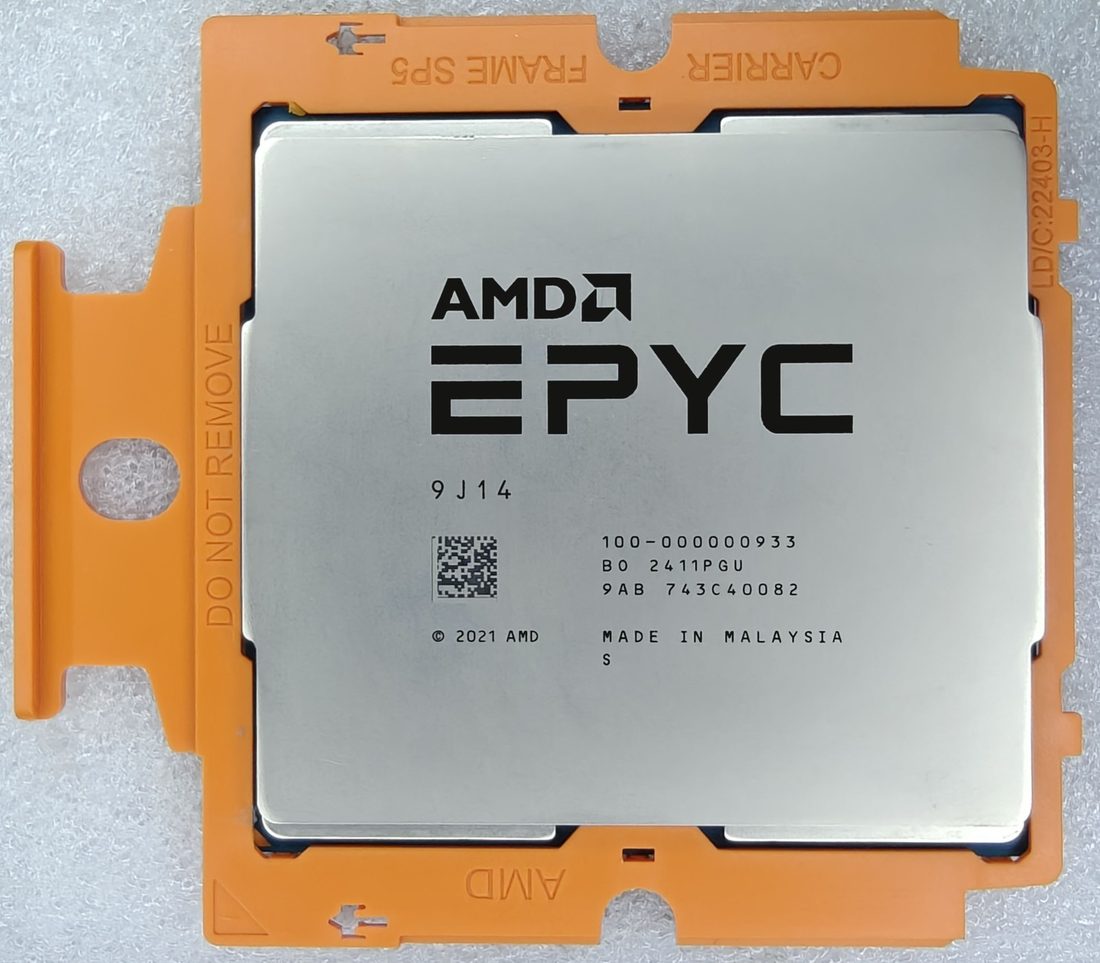
EPYC 9J14
Photo from the EPYC 9J14 page. Every unit's label is read against your order before dispatch.
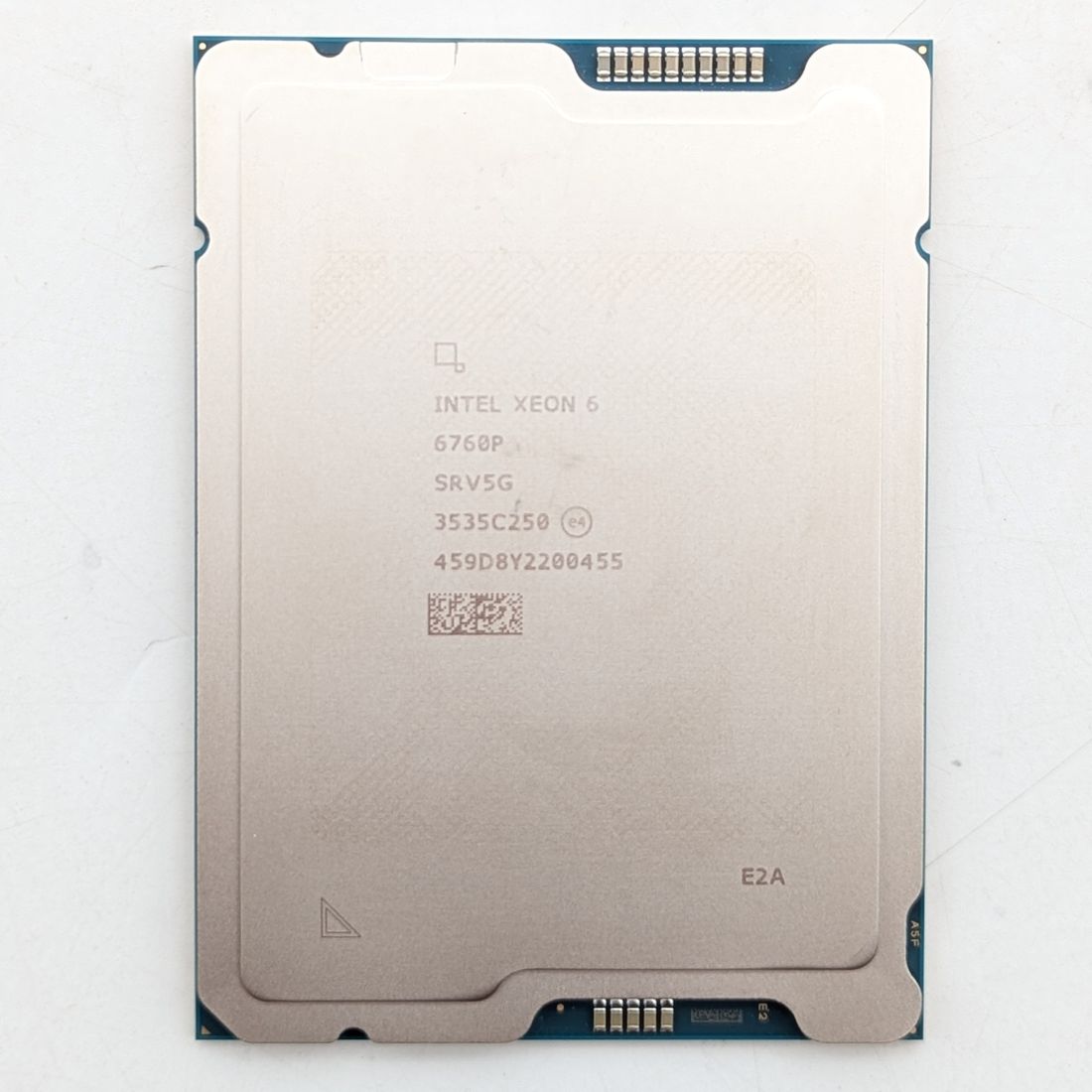
Xeon 6760P
Photo from the Xeon 6760P page. Every unit's label is read against your order before dispatch.
Frequently asked questions
How much do the EPYC 9J14 and the Xeon 6760P cost?
We do not publish prices for either: DRAM and CPU pricing moved too fast in 2026 for a printed figure to stay honest. Send the quantity, the platform and the condition you want and we quote both against confirmed stock, with the date the figure holds until.
What is the main difference between the EPYC 9J14 and the Xeon 6760P?
Cores / Threads (EPYC 9J14: 96 cores / 192 threads per CPU; Xeon 6760P: 64 cores / 128 threads); TDP (EPYC 9J14: 360W in OEM/secondary-market listings for this OPN; not confirmed by an AMD-published document; Xeon 6760P: 330 W / Intel 3); Cache (EPYC 9J14: 384MB in OEM/secondary-market listings for this OPN; not confirmed by an AMD-published document; Xeon 6760P: 320 MB).
Can I use the EPYC 9J14 and the Xeon 6760P in the same system?
No. They use different sockets (SP5 (LGA 6096) vs see spec), so they need different server platforms and cannot share a board.
Which one should I buy?
Buy the one whose strong points match the job: see the "Choose" section above. If you are replacing an existing part, send the platform or the old part number and we will confirm compatibility before you order.
What condition are they in, and do you ship worldwide?
Both are supplied tested with a 1-year written warranty. Condition is stated line by line before you order — new, decommissioned pull or OEM tray — and we ship worldwide from the Hong Kong warehouse with full export documentation, typically 3–7 days by air.
Get a quote for either — or both
Tell us the quantity, the platform and the condition you need. We confirm stock and put a firm figure in writing with the date it holds until.
Request a Quote